Heidi Haavik’s
Level 2 – Neuro Model

Thank you for joining the Platinum Program and for taking on this challenge. This program is designed to help you and your team deepen your understanding of the neuroscience behind chiropractic care and become more confident communicating the science of what we do.
We are now moving into Level 2: Neuro Integration. This level builds on the foundations introduced in Level 1: The Brain Model of Chiropractic. If you have already completed Level 1, this next stage will help you integrate and apply that knowledge in a deeper way. If you are new here, that is completely fine too. Level 1 remains available to you and can be completed at any time as the foundational course.
Our goal with this program is to help chiropractors truly understand the nervous system and how chiropractic care interacts with it, so that you can communicate with clarity, confidence and scientific credibility. I hope you enjoy the journey. I would love to hear how you go, so please feel free to reach out at any time at support@chiroshub.com.
BLOCK 1
Foundations: How the Nervous System Signals and Adapts
Understand the basic “rules” of neural signalling so clinical responses start to make sense.
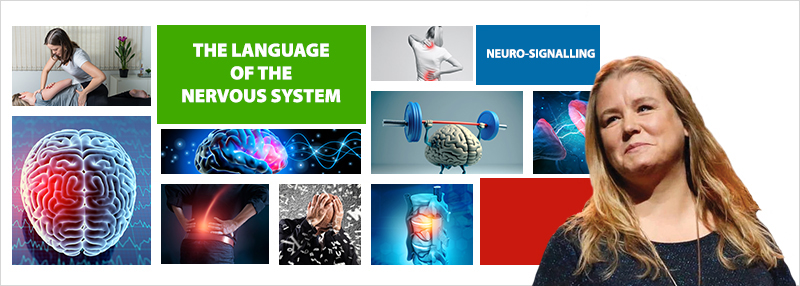
The Language of the Nervous System
How neural signalling, load, and timing shape adaptation
Clinical focus
- Why some patients respond quickly and others slowly
- Why flare-ups happen
- What neural signalling tells us about care pacing
- Establishing a shared neurological language (playful, safe, non-threatening)
NS1.01 Neurobiology of the Neuron
56 Minutes – The basics of one of the two main cell types found in the nervous system.
NS1.02 Neurobiology of the Glial Cells
93 minutes – Be able to discuss the anatomy and function of the most common glial cells.
NS1.03 The Nerve Cell Membrane
48 minutes – this class details how the brain functions and the mechanisms behind nerve impulses.
NS1.04 The Action Potential
42 minutes – gain a solid grasp of the action potential’s role in our nervous system.
NS1.07 Sensory Processing
60 minutes – a deep dive into the realm of Sensory Processing Integration.
BLOCK 2
From Signal to Perception: How the Brain Interprets Input
Understanding the move from raw signals → meaning → perception → a person’s reality
From Input to Perception: Understanding the Brain’s Response to Chiropractic Care
Clinical focus
- Revisiting sensory processing and cortical anatomy
- The key brain regions research suggests are influenced by chiropractic care
- What these brain areas are known to do in health and function
- How changes in these networks may relate to pain, movement, sensorimotor integration, autonomic regulation, and performance
- Integrating the neuroscience into clinical practice without overclaiming
- Interactive brain anatomy review with quizzes and case-based discussion
NS1.05 The Synapse
50 minutes – Understand the fundamentals of the synapse
NS1.06 Cortical Anatomy
66 minutes – the layers of complexity surrounding the cerebral cortex.
NS1.09 Neurotransmitters
61 minutes – a comprehensive overview over the different types of neurotransmitters there are.
BLOCK 3
Adaptation & Regulation: How Change Becomes Lasting
Explain where and how longer-term change is coordinated in the brain.
When Change Becomes Stable
Why function, confidence, and coordination often improve before pain
Clinical focus
- Changes in coordination, clarity, confidence, and effort
- Why patients say “I just feel better” before symptoms change
- Cerebellar and prefrontal contributions to adaptability
- How this aligns with common chiropractic clinical observations
NS1.08 Neural Plasticity
49 minutes – the cellular mechanisms that underpin neural plasticity
NS1.10 The Prefrontal Cortex
63 minutes – a nexus of neurological brilliance that shapes the very essence of our human experience.
NS1.25 The Cerebellum
72 minutes – learn about the major anatomical divisions of the cerebellum.
BLOCK 4
From Sensation to Movement: Output Matters
Tie sensory input to motor output and functional change.
A Deep Dive into the Subluxation
Why better movement changes the brain
Clinical focus
- Proprioception as a driver of regulation and how subluxations alter this
- Why movement confidence matters and how this changes with ageing
- Reflexes, coordination, and spinal input
- Clinical reasoning around movement, adjustment, or both
NS1.11 The Somatosensory System and Tracts
72 minutes – a concise yet comprehensive look at how our bodies perceive and transmit sensory information.
NS1.13 Motor Control and the Corticospinal Tract
64 mins – a crucial superhighway that links your cerebral cortex to your spinal cord
NS1.14 The Muscle Fiber and Neuromuscular Junction
49 minutes – learn about the anatomy of skeletal muscles down to the individual muscle fibers
NS1.15 Proprioception and Reflexes
50 minutes – how your body navigates the world with precision.
BLOCK 5
Protection, Pain & Integration: Making Sense of Complexity
Bring everything together without becoming “pain-science heavy”.
A Neuro-Informed Chiropractic Model That Makes Sense
Clinical focus
- How subluxation can be discussed using modern neuroscience language
- Helping chiropractors speak confidently with patients and peers
- Integrating nervous system, movement, pain, and adaptation into a coherent clinical model
NS1.12 The Meninges of the Brain and Spinal Cord
44 minutes – the mysteries surrounding the protective membranes of the brain and spinal cord.
NS1.16 Pain The Danger Warning System
78 minutes – the complex world of pain.
NS1.31 The Neuroimmune Connection
72 minutes – interaction between nervous system and immune system.